Texts and Data: Measuring the Impact of Words with AI and Frameworks
Date
30 June 2025
by Aurora Zotto
How to Measure the Value of Words (and Why Do It Now)
The widespread adoption of Artificial Intelligence (AI), including in copywriting and communication, is redefining the role of words in digital business. In a market where user attention is a scarce resource and competition moves at an increasingly rapid pace, a brand’s ability to stand out through messaging is not just a matter of style: it is a strategic lever.
Yet, while layouts, graphics, and wireframes are being tested, copy often remains excluded from validation and optimization processes. This is a limitation that we can now overcome. Thanks to the integration between established analytical frameworks and advanced language models, it is possible to objectively evaluate the effectiveness of a message and make targeted improvements. This article explores how to do it.
What We Will Cover in This Article:
- Beyond copy: measuring the impact of messages with AI and strategic frameworks
- Communication and differentiation: a strategic urgency in saturated markets
- What “testing words” really means
- The limits of quantitative data and the role of qualitative analysis
- Strategic frameworks to analyze and optimize messages
- Prompt design: orchestrating AI strategically
- Testing and validation: integrating quality and quantity
- Conclusions
Beyond Copy: Measuring the Impact of Messages with AI and Strategic Frameworks
In today’s competitive marketing landscape, textual communication plays a role that goes far beyond simply transmitting information. Words are now among the most relevant strategic assets: they are the first to capture the user’s attention, the first to communicate positioning and differentiating value, and often the only ones capable of triggering conversion in a digital context dominated by distraction and information overload.
However, copy is still often treated as an accessory component of design, without a real validation process. This is where SAY’s methodological proposal comes in: an approach that integrates Artificial Intelligence (AI) and analytical frameworks to measure, test, and optimize messages, making them a measurable and scalable business tool.
Communication and Differentiation: A Strategic Urgency in Saturated Markets
The exponential increase of Martech solutions has profoundly transformed access to technology for companies. Today, anyone — even an early-stage startup — can rely on sophisticated tools to build competitive digital experiences. But if technology becomes a commodity, what remains as the true battleground is communication.
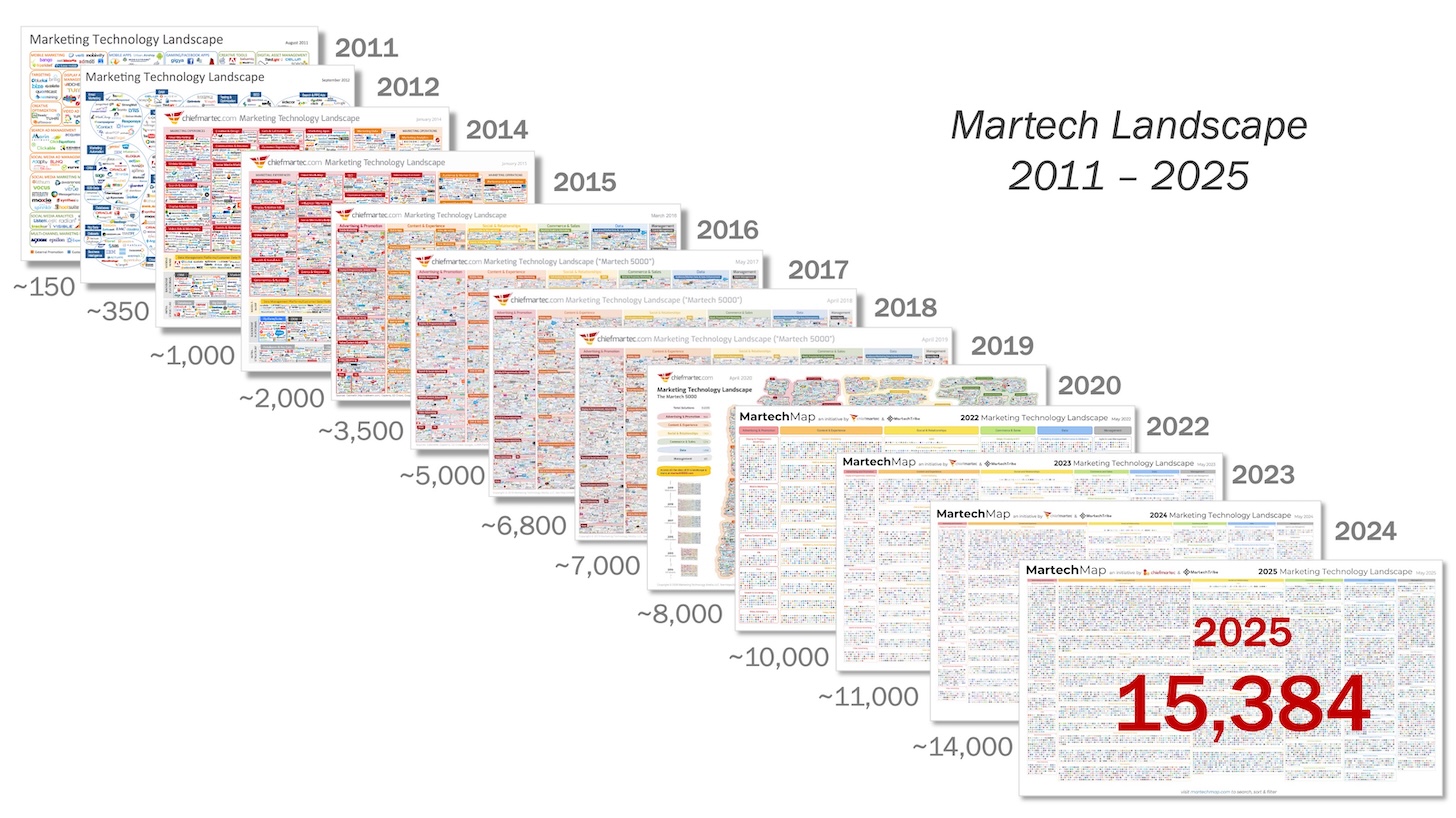
Martech landscape, 2011-2025
In this scenario, the greatest risk is homogenization: brands operating in the same sector end up communicating in similar ways. This phenomenon, defined as “sameness” by Peep Laja (founder of CXL and Wynter), leads to a net loss of recognition. Competition is no longer just between products, but between messages. And when everyone says the same things, the only way to stand out is to improve how you say them.
True differentiation today is played out in perception, which is built word by word: from the first headline to the microcopy on a button, to the description of a product or service. It is in these details that brand identity is formed and user trust is built.
What “Testing Words” Really Means
Testing copy means putting it to the test not only in terms of conversion, but also in terms of perception. It means measuring whether a headline is clear, whether a CTA is effective, whether a description conveys value. Each message must answer a precise question: does it really work for the reader?
Message analysis at key points must be done before publication, through qualitative tools, analysis, and simulations, but also after publication, with observational data and real feedback.
With the adoption of AI and advanced language models, it is now possible to introduce linguistic validation processes for copy, drastically reducing the time between hypothesis, testing, and learning. But to do this, tools, frameworks, and a clear, verifiable methodology are needed.
The Limits of Quantitative Data and the Role of Qualitative Analysis
Quantitative tools provide detailed metrics on user behavior: clicks, scrolls, time on page, bounce rate. However, this data describes “what happens,” but rarely explains “why.” It lacks qualitative insights, which are essential for understanding the real effectiveness of texts.
To fill this gap, numbers must be complemented by a qualitative approach that measures:
- perception
- emotional impact
- clarity of messages
This is where Artificial Intelligence can make the difference: through semantic analysis and frameworks, it is possible to achieve a deep and scalable evaluation of the language used by users and of the persuasive power of content.
Strategic Frameworks to Analyze and Optimize Messages
The strategic measurement of messages can be based on a series of frameworks, each of which provides a precise angle to analyze copy performance. Here are the main frameworks and operational models to base content analysis and improvement on:
Jobs-To-Be-Done (JTBD): identifies the real needs of the user, shifting focus from product features to the concrete outcome the user wants to achieve. It is particularly effective when applied on a large scale through AI analysis of real reviews and comments.
Message Mining: works at a linguistic and semantic level, extracting patterns, recurring phrases, and key adjectives from users’ spontaneous language. The resulting data can be translated into operational material for headlines, descriptions, and microcopy with high perceptual relevance.
ICE (Impact, Confidence, Ease): a prioritization model that helps determine which interventions have the best balance between expected impact, probability of success, and ease of implementation, optimizing resources and guiding optimization decisions.
LIFT Model: evaluates each component of the message based on six key levers: value proposition, clarity, relevance, urgency, anxiety, and distraction. It is a useful tool to highlight weaknesses and generate structured hypotheses for improvement.
Fogg Behavior Model: based on the equation B=MAP (Behavior = Motivation + Ability + Prompt), it is useful for understanding whether texts, CTAs, and headlines lack motivation, execution simplicity, or an adequate trigger, helping to understand why a user does not act.
Hick’s Law: requires cognitive simplification of messages, reducing the number of possible options and focusing attention on a single priority message. It helps eliminate decision paralysis caused by excess choice.
CRAFT Framework: guides the transformation of AI-generated outputs into high-quality editorial content through five operational steps: cutting the unnecessary, stylistic optimization, inserting visual elements, source verification, and building trust. It is designed to integrate AI into the content production workflow while ensuring high quality standards.
PAS (Problem, Agitate, Solve): a classic model enhanced by AI to create empathetic and high-engagement messages. Based on real data collected (e.g., reviews), it helps structure content that identifies the need, emphasizes its urgency, and proposes a concrete solution.
Integrated into an operational flow, these frameworks offer a complete map to evaluate, correct, and strengthen any textual content with a scalable, measurable logic deeply oriented toward conversion.
Prompt Design: Instructing AI Strategically
The quality of output generated by Artificial Intelligence is directly proportional to the quality of the input it receives. That is why prompt design, or prompt engineering — the ability to structure the request to the AI strategically, clearly, and completely — is now a fundamental skill.
Writing a good prompt does not simply mean “asking a question,” but building a complete instruction that includes:
- the role AI must assume (e.g., copywriter, CRO and UX specialist, semantic analyst)
- the operational context (product, target, channel, tone of voice)
- the communication goal (rewrite a CTA, generate a headline, reformulate a value proposition)
- formal or stylistic constraints and output format (maximum word count, structure, required language)
- examples of desired outputs
The approach completely changes the result: a precise and well-constructed prompt delivers coherent, usable content aligned with objectives.
At SAY, prompt design is integrated into the Performance team workflow as a strategic asset and is built together with data collected during research and analysis, ensuring semantic relevance and expressive quality from the very first content generation.
Testing and Validation: Integrating Quality and Quantity
Measuring the effectiveness of a message requires integrating quantitative and qualitative approaches. On one hand, A/B testing allows hypotheses to be validated on a large scale with real, measurable data, especially in high-traffic contexts. On the other hand, tools like heatmaps, click maps, and session recordings reveal where users focus (or lose) their attention. But these data alone are not enough: qualitative tests, such as message testing, surveys, and feedback, are also necessary.
AI now makes it possible to automate and amplify these processes: thanks to language models, it is possible to generate variations, evaluate readability, persuasion, empathy, and correlate outputs with real performance. This makes copywriting an iterative process that learns and improves from user behavior. Only in this way can we create content that is not just well-written, but also measurably effective.
Conclusions
In a digital ecosystem where competition increasingly depends on clarity, relevance, and effectiveness of messaging, words must be designed, tested, and optimized. AI technologies and frameworks make it possible to transform copy into an operational asset, based on real insights and measurable performance.
Integrating these tools into workflows is not just an opportunity to accelerate production: it is a way to elevate quality, scale message effectiveness, and strengthen alignment between communication and business goals.
In summary:
- Words can (and must) be measured.
- Writing well is not enough: testing is essential.
- Frameworks provide structure, AI accelerates the process.
- Copy effectiveness is measured by results, not personal preferences.
Want to Bring This Approach Into Your Team?