Brand Awareness vs Performance: How to Find the Right Balance
Date
27 October 2025
For years, the world of marketing and communications has been divided between two schools of thought: those advocating long-term brand building on one side, and those demanding measurable, immediate results on the other. Brand or performance? Awareness or conversion?
Today, in an increasingly competitive landscape, this divide risks being not only outdated but also harmful. Growth doesn’t come from choosing one side, it comes from designing the right balance.
At SAY, we want to help marketers and decision-makers move beyond this sterile dichotomy and build strategies that are conscious, measurable, and sustainable.
The Polarisation Between Branding and Performance
The obsession with short-term results, fueled by the availability of real-time data, has led many brands to disproportionately invest in performance-driven activities. The outcome?
- Rising CPAs and declining performance
- Lack of differentiation in the market
- Low memorability, weak trust, stagnant growth
As Les Binet and Peter Field showed in their landmark study The Long and the Short of It, brands that balance short- and long-term investment grow faster. The ideal ratio? Roughly 60% of budget in brand building, 40% in performance. Of course, the exact mix depends on context, critical thinking, and expertise.
Similarly, Dan White highlights an inevitable duality:
“Marketing must create value today, while also building the value of tomorrow. The two must never be managed separately.”
The Messy Middle Has Killed the Funnel
The classic funnel model, awareness, consideration, conversion, no longer reflects how people actually behave.
Consumers now move within a Messy Middle: a complex, non-linear space where they explore, compare, go back, and jump ahead. Here:
inspiration might spark from a YouTube video and turn into a purchase in just a few clicks;
a banner ad may be forgotten, or, if designed well, influence a decision weeks later;
awareness acts as activation, and performance also builds brand.
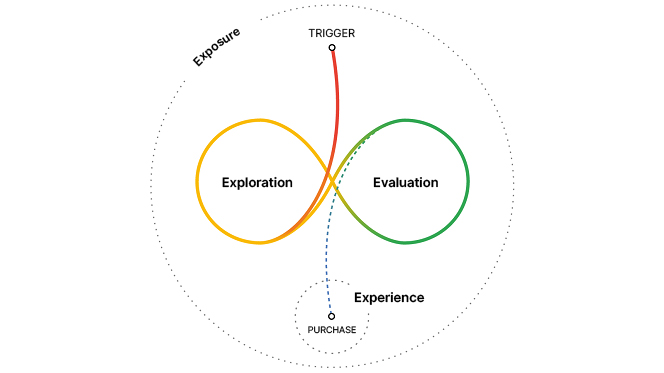
In this context, brand and performance are not sequential phases but simultaneous functions. The marketer’s role is to design touchpoints that are relevant, memorable, and actionable, every single day.
What Brand Awareness Really Means
In the events we’ve attended and hosted, we often break down brand awareness into three essential dimensions:
1. Brand Recall (Notoriety)
Being remembered. Measurable through surveys with specific questions, or through branded search volumes that can also feed into SOS (Share of Search) metrics.
2. Familiarity (Affinity & Relevance)
Being recognised and perceived as relevant. A brand becomes the “natural choice” when it maintains consistency, a clear tone of voice, and a strong identity.
3. Mental Availability
Being the first brand that comes to mind when needed. Byron Sharp defines this as more important than brand love: mental availability drives choice. Awareness isn’t just visibility. It’s being chosen without having to persuade.
How to Balance Brand and Performance
Building the right mix means working across four pillars.
1. Conscious Measurement
Advertising platforms only show part of the picture. To go beyond the limits of traditional attribution models, we need awareness, and above all, a mindset shift.
Not everything that can’t be measured is irrelevant. And not everything that can be measured is truly important. Vanity metrics often distract us from real business impact.
2. External Influences
Performance must be analysed in context, taking into account external factors such as seasonality, competitor activity, and economic or industry trends. Technical aspects, often overlooked, like ad saturation and adstock (the prolonged effect of advertising exposure) must also be considered.
3. Test, Test, and Test Again
Experimentation isn’t optional: it’s essential. Incrementality tests, such GeoLift, allow us to measure the true impact of campaigns, separating direct causality from placebo effects. This is the only way to validate models and strategies.
4. Rigour with Perspective
Data alone never tells the full story. A number taken out of context is an illusion of precision. Only through conscious analysis that combines method, intuition, and contextual knowledge can we turn measurement into growth.
Choosing the Right Mix (Not the Right Channel)
In modern marketing, there are no “pure” channels or isolated objectives. Every channel can contribute, in different ways, both to brand building and to driving performance. A YouTube campaign can generate direct sales. A Search campaign can strengthen brand image when paired with the right creative
The key isn’t to assign one objective per channel, but to design a media ecosystem where:
- Channels work in synergy: real impact happens when messages flow consistently across multiple touchpoints
- Creativity, targeting, and timing make each channel more effective: a well-crafted emotional asset can even work within Google Search, if designed accordingly.
- Strategy must also account for context: consumer behaviour in the Messy Middle demands a continuous, coherent, and diversified presence.
For this reason, rather than distinguishing between awareness channels and performance channels, we prefer to talk about media ecosystems, designed to operate in an integrated and coherent way.
An effective ecosystem is built not to separate awareness from performance, but to increase visibility, build trust and familiarity over time, enable conversion at the right moment, when cognitive, emotional, and contextual conditions align.
What truly matters is not the tool itself, but the architecture around it: the strategy, the creative, the timing, and the interplay between touchpoints.
In other words: the real value lies in finding the right mix. That’s where effectiveness lives.
What SAY Can Do for You
At SAY, we help brands thrive in the Messy Middle by consciously balancing brand and performance.
Here’s how we can support you:
Strategy, Positioning & Objectives
- Defining brand identity and distinctive values to build a coherent, memorable brand
- Analysing competitive landscapes and cultural tensions to identify authentic opportunities for differentiation
- Building strategies to align media and creative choices
- Ensuring business and communication objectives work together—not against each other
Creative That Builds and Converts
- Developing strategic creative designed to stand out in the chaotic moment of choice
- Continuously testing visuals and messaging across different environments and audiences
- Designing cross-channel content in line with people’s hybrid behaviour
Continuous Measurement & Optimisation
- Bespoke dashboards that integrate business data and media insights for truly data-driven decisions
- Custom Marketing Mix Modelling that accounts for channels, external factors, and incremental impacts
- Adstock and saturation curves to assess how long campaigns last and how much they really deliver
- Incrementality tests at both local and national scale, to validate hypotheses and maximise ROI
Conscious Marketing First
It’s not about choosing between brand or performance. It’s about building conscious marketing: marketing that reads the context, anticipates user behaviour, and navigates both short- and long-term growth.
“Don’t just settle for knowing what worked. Find out why.”
SAY S.p.A.
Curious to know if you’re over-investing in performance and under-investing in brand?