In the Age of AI, Public Relations Matter More Than Ever
Date
14 July 2025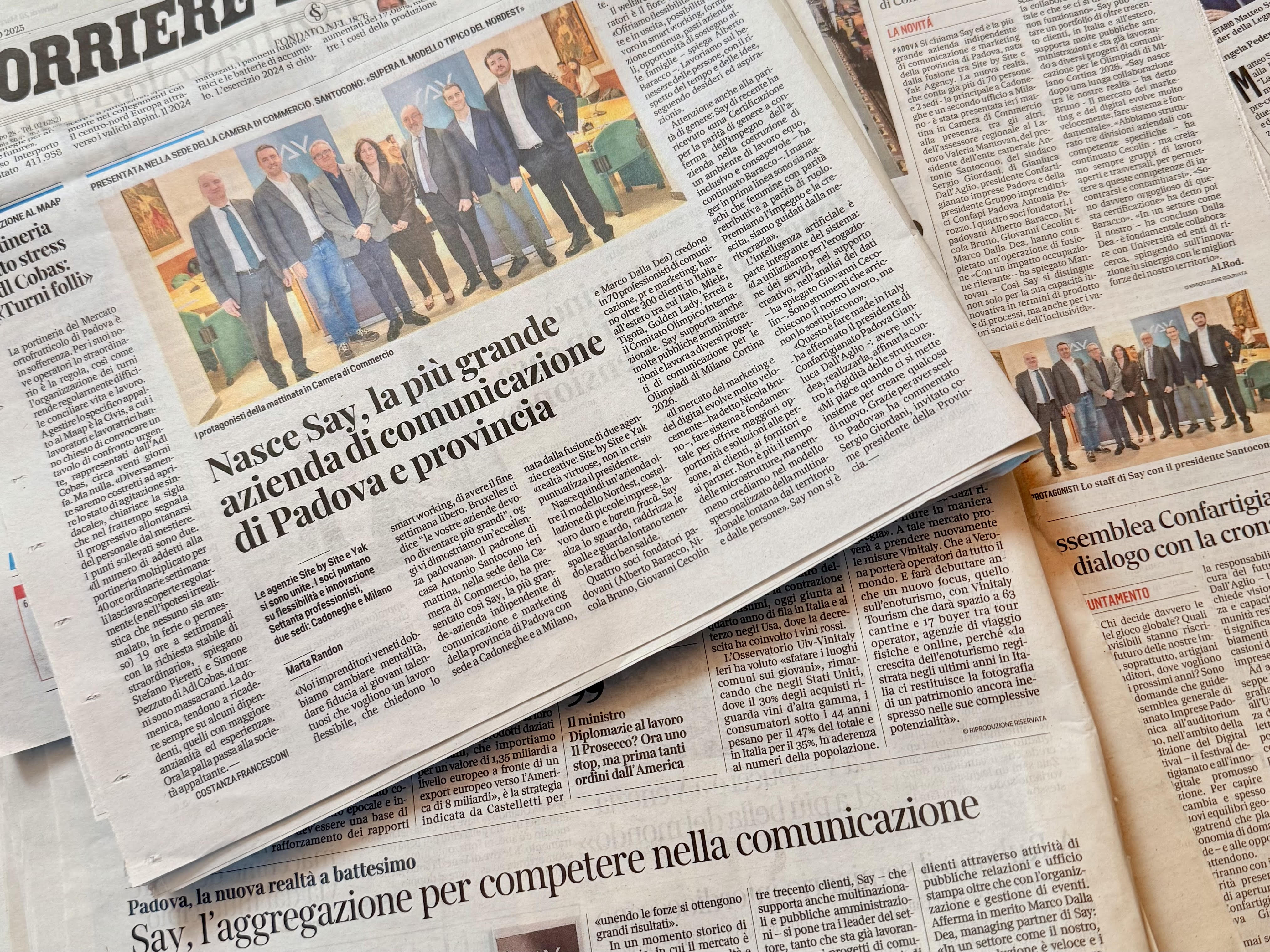
We live in an era in which generative artificial intelligence has become capable of creating texts, images, videos, and audio indistinguishable from those produced by humans. In a world where everything can be generated, modified, simulated—what can we still consider “true”? Who can we really rely on to understand it?
These are the questions we posed at the beginning of our recent presentation titled “Artificial Intelligence: Threat or Opportunity?”, which SAY held at Spazio 35 of the San Gaetano Cultural Center, as part of the Punti Digitale Facile project promoted by the Veneto Region.
The key point is to understand how today a brand or organization can ensure authenticity, authority, and relevance, and therefore a good brand reputation, in a context where AI can generate any content, including false ones.
The topic is more relevant than ever: distrust in content, caused by the advent of artificial intelligence, is already a reality in the market. According to Eurobarometer, 80% of European citizens are in favor of AI regulation, while a survey published by the European Parliament in 2024 reveals that 87% of respondents consider it important that Europeans be protected against risky or unethical applications of digital technologies, including artificial intelligence.
Our response is twofold: on the one hand, a conscious use of AI in different business functions; on the other, a renewed importance of Public Relations (PR), as a fundamental tool for brand reputation.
What we will cover in this article:
What Public Relations (PR) are and what a PR agency does
Public relations (PR) are the set of strategies and activities aimed at building, consolidating, and protecting the reputation of an organization or a person among its reference audiences: clients, media, institutions, stakeholders, and the general public.
The job of a PR agency is to manage the Client’s communication in a credible, consistent, and strategic way, taking care of what is said, how it is said, and through which channels. Particular attention is paid to media channels: newspapers, magazines, registered online publications, newsletters curated by journalists, and, more generally, any means of communication that bears the “signature” of a recognizable, authoritative subject subject to specific regulations—such as a journalist registered with the professional body.
A PR agency helps the Client be heard at the right times, by the right people, with the right words. It plays the role of “mediator” between the company and the external ecosystem, offering skills that range from strategic writing to media training, from online reputation management to building relationships with journalists.
In practice, this means contributing to the definition of corporate positioning, identifying key messages, preparing spokespersons, drafting press releases, organizing conferences or interviews, monitoring media coverage, and preparing crisis management plans to protect the image of the brand or organization.
In a context dominated by generative AI (and the deviations of disinformation), this work gains even greater value: PR are not limited to “making news,” but to building trust.
It is not about storytelling for its own sake. A good PR agency does not invent stories: it helps bring out the true ones, in the most effective way. It is a Copernican revolution: PR ensure that other subjects, third parties and authoritative (the media), speak about the client’s brand or organization, thus breaking the loop of self-referentiality.
Why do public relations help build trust?
In recent history, we built our trust in content thanks to its testimonial strength: a photo, a document, a video were “proof” of what had happened. Today, this is no longer the case.
Online we can stumble upon endless AI-generated images, from the funny kitten to the fake footage of Donald Trump’s arrest, from bogus audio to (fake) photos of the Pope wearing a rapper-style puffer jacket… false content, sometimes amusing and sometimes worrying, that remind us of one thing: we have lost our digital innocence. AI’s ability to imitate reality has surpassed our ability to distinguish it from falsehood, and this fuels consumer distrust, especially when consumers are looking for confirmation or certainty.
Nowadays, in short, it has become more complex to build brand reputation solely through content produced or distributed firsthand by companies and organizations. Such content remains fundamental but is no longer sufficient.
Of course, we do not intend to demonize AI: AI tools offer great opportunities for brands and organizations, for example in streamlining processes and creating both textual and visual content, and they are studied, developed, and used by us at SAY in many contexts. But it is in the awareness of the limits of these tools that true opportunities lie: precisely because it is easier today to create content, gaining trust through a qualified medium allows us to stand out from the background noise of the web and increase both brand awareness and, precisely, brand reputation.
Why PR matter more than ever today
This is precisely where public relations come into play. In a context of overproduction and manipulation of content, people no longer seek only information. They seek mediation. They seek authoritative figures and sources capable of distinguishing, filtering, and interpreting. In short, they seek an anchor for trust.
Journalists, qualified experts, certified sources, and PR professionals therefore return to a central role: building bridges of trust between companies and the public, guaranteeing transparency and critical sense.
Europeans (and Italians) are returning to trust the media
According to the Eurobarometer published by the European Parliament in 2022, EU citizens show greater trust in traditional media compared to online platforms and social media. 49% consider public broadcasters the most reliable news sources, followed by the press (39%) and private broadcasters (27%).
An OECD survey in 2023 found that 39% of people in the 38 member countries have high or moderately high trust in the media. By contrast, only 20% of EU citizens say they trust social networks as a source of news.
Even in Italy, trust in traditional media is returning—after a setback in the early 2000s, when the advent of the internet triggered a profound crisis in the organizational and economic models of information.
The sector in fact has a solid regulatory basis—being governed by precise rules and oversight bodies that ensure transparency and accountability—that allows Italian media to act as qualified mediators. The profession of journalist is regulated by Law no. 69 of 1963, which established the Order of Journalists. To practice the profession, it is necessary to be registered, to pass an exam, and to respect a body of ethical codes that impose principles such as the substantial truth of facts, respect for sources, and the duty of correction. Italian journalists are also subject to the supervision of the Disciplinary Council of the Order, which can sanction misconduct. There are also independent authorities, such as AGCOM (Authority for Communications Guarantees), which oversees pluralism, balance of information, and fair access to media. Finally, public services such as RAI must respect obligations of public service and impartiality.
In an age of information overload and online disinformation, this regulatory and professional infrastructure represents a guarantee: Italian traditional media are certainly not perfect, and are clearly influenced by the positions of their respective publishers, but they are nonetheless accountable for what they publish—unlike digital platforms, where rules and effective controls are often lacking.
For this reason, consumers are returning to consider regulated media as a fundamental resource for orienting themselves critically and reliably in the information landscape.
What to look for in a public relations agency
In this context, companies and organizations have begun to refocus on public relations activities. But what should you look for in a public relations agency? How do you choose the PR agency to collaborate with?
When a company chooses a PR agency, it must carefully evaluate some fundamental elements:
The composition and quality of the agency’s team: a serious agency has qualified personnel, with communication professionals and journalists—professionals and publicists—registered with the Order, able to guarantee compliance with current regulations and ethical codes, and to approach the media effectively while respecting the ethics of the profession. This is crucial to building reliable messages, especially in regulated or sensitive fields.
Concrete experience in the field: PR cannot be improvised; they require years of work on real cases, crises managed, with relevant brands and organizations, and relationships built with the media. An agency with a solid history has had the time to build trust with journalists, newsrooms, and opinion leaders—relationships that cannot be built in a few months but that are decisive for obtaining credible and authoritative attention.
Corporate solidity and reputation: this is a guarantee for the Client; choosing a stable partner means relying on an organized structure, with proven processes, strategic vision, and the ability to support the company over time, even in delicate moments.
In summary, an effective PR agency is not only creative but also prepared, reliable, and well-rooted in the media system.
SAY can help you rediscover the value of PR
SAY S.p.A., a communication and marketing company born from the merger of YAK Agency and site By site, has more than twenty years of experience in the field of PR and can count on a team of over 70 people between the Padua and Milan offices—including several journalists registered with the Order (both publicists and professionals).
Over the years, we have managed public relations for major national and international companies, developing proactive and reactive plans, handling reputational, union, and safety crises, organizing press conferences, interviews, media tours, and ensuring that our clients’ voices reached their targets and were heard. We have also collaborated with international organizations, managing public relations activities in the non-profit and sports sectors, contributing to the realization—among other events—of six different Olympic editions.
If you want to know more about how SAY can help your company navigate the present and build reliable communication even in the era of artificial intelligence, write to us: info@sayagency.com